


Main pathogens causing diarrhea in pig production in the USA
Pig diarrhea is common at the neonatal and post-weaning stages and is a frequent cause of mortality. These consequences add up to the treatment costs and the worsening of the productive performance. Diet changes, particularly weaning, and movement of pigs from the different facilities (farrowing house, nursery, grower-finisher) are the most stressful events and mark when pigs are more prone to suffer from diseases, including enteric infections.

Pig diarrhea is common at the neonatal and post-weaning stages and is a frequent cause of mortality. These consequences add up to the treatment costs and the worsening of the productive performance. Diet changes, particularly weaning, and movement of pigs from the different facilities (farrowing house, nursery, grower-finisher) are the most stressful events and mark when pigs are more prone to suffer from diseases, including enteric infections.
Índice de Contenidos
Main causes of diarrhea in pigs in the USA
According to VanderWaal & Deen (2018), the most common pathogens of swine in North America since 2006 are PRRS, Salmonella, E. coli, PCV 2 and Staphylococcus aureus. Three out of these five are important causes of diarrhea (Salmonella, E. coli and PCV 2), which shows how important enteric disorders are in swine. These three pathogens are followed by Clostridium, coccidia and rotavirus as the main causes of diarrhea in pigs in the United States.

Signs and affected ages by microorganism
Salmonella (all age groups)
It is an important disease for its capacity to be zoonotic. In pigs, it causes diarrhea, systemic disorders, and/or pneumonia. The most common serotypes isolated in pigs are Cholerasuis and Typhimurium. Salmonella Cholerasuis does not usually affect humans but can produce severe disease, including diarrhea, in pigs. S. Typhimurium causes diarrhea in young pigs and frequently affects humans.
Pigs from 10 to 16 weeks of age can suffer salmonellosis, too, which usually appears as a secondary disease. Acute infections cause prostration, diarrhea, fever, and sudden death. Chronic infections cause growth stunt, diarrhea, and worsening of performance.
Vaccines can be an effective protective tool, as they sometimes have cross protection between the two serotypes. Biosecurity measures are strongly recommended, as well as the administration of immunostimulants with vaccinations.
E.coli (neonatal)
It is an important pathogen in pig production as it is a serious cause of diarrhea. Usually, it affects pigs during the first week of life and the first week post-weaning.
In piglets, it comes from the mother and usually affects the whole litter, causing high mortalities due to dehydration. In weaned pigs, E. coli takes advantage of the decrease in the antibodies obtained via colostrum. Mortalities are not so high, and diarrhea is less severe (white-yellow-brown diarrhea, no blood). This bacterium can also produce toxins that can cause different diseases.
It is important to make sure that colostrum’s immune quality is good enough to protect piglets during the first weeks of life, which can be done with immunostimulant pronutrients.
PCV 2 (all age groups, but more serious in neonates)
Porcine coronavirus type 2 (PCV 2) causes Porcine Endemic Diarrhea (PED), a devastating enteric disease reportable to the USDA: in 2013, the virus spread from China to the US and affected 50% of all breeding herds within one year, resulting in millions of deaths (VanderWaal & Deen, 2018).
The disease is much more severe in neonates, causing high mortality. In older animals, despite signs are not so severe, it can have long-term effects on performance.
The lack of immunity is one of the most important predisposing factors. For this, vaccines are available in the USA and immunostimulants can be used to improve the vaccines’ efficacy.
Clostridial infections (neonatal)
Clostridium perfringens types A and C (also types B and C, but rarely) are associated with enteritis and diarrhea, particularly within the first week of life. It takes advantage of other pathogens, such as coccidia or rotavirus, to cause an infection.
Type C usually affects piglets during the first week of life with acute bloody diarrhea. In weaned pigs (2 to 4 weeks) it causes hemorrhagic enteritis. The most important source of infection is the sow (Songer & Uzal, 2005). Type A is a part of the normal flora of pigs, and usually develops at the first week of life, causing creamy, pasty diarrhea.
Coccidia (neonatal)
Eimeria and Isospora are the coccidia genera that affect pigs, and most of the outbreaks are caused by I. suis in lactating animals of around 9 days of age.
The clinical picture includes yellow-greyish diarrhea that causes dehydration and considerable weight loss. Older pigs suffer from pasty stools or subclinical disease that affects long-term performance.
Rotavirus (neonatal)
It is a common cause of diarrhea in nursing and weaned pigs, and it is more prevalent in week 4. It causes a mild disease, with white scours, that leads to secondary infections (e.g. clostridiosis or salmonellosis). It can become severe if the infection is combined with E. coli or other pathogens.
The virus persists in the environment and can infect other pigs when immunity obtained with colostrum decreases, making them susceptible (Wills, 2000).
Other causes that are worth to mention
-
Porcine dermatitis-nephropathy syndrome (PDNS)
- Caused by Actinobacillus suis, this disease is transmitted vertically and characterized by affecting the lumboaortic lymphnode chain from caudal to cranial, which causes immunodeficiency.
- Newborn piglets already have the caudal pair of lymph nodes affected and suffer kidney disorders. The disease evolves cranially and, when the mesenteric and stomach’s lymphnodes are affected, these organs lack of immune protection and the animal can easily suffer secondary enteric infections by E. coli and other microorganisms.The disease should be prevented using an vaccine in combination with immunostimulant pronutrients (for more information visit www.veterinariadigital.com/en/articulos/porcine-dermatitis-nephopathy-syndrome-and-its-inmunological/).
-
Transmissible gastroenteritis (TGE) (all age groups, but more serious in neonates)
This disease is also caused by a coronavirus (porcine respiratory coronavirus, PRCV), and surveys indicate that it is widespread throughout the US. Initial outbreaks are acute and can cause up to 100% neonatal mortality. Milder, endemic forms persist in some herds.
-
Diarrhea in growing and finishing pigs
The pathogens commonly associated with diarrhea in these stages are, apart from Salmonella spp., Lawsonia intracellularis (proliferative hemorrhagic enteropathy) and Brachyspira spp. (mucous diarrhea).
Natural prevention strategies
The best way to avoid these diseases is through the rapid detection, diagnosis and the implementation of treatment and prevention strategies.
Pronutrients
Among the natural strategies to prevent these diseases, products based on pronutrients clearly stand out. They are active molecules from plant extracts that stimulate the physiology of the target cells by inducing the expression of specific genes of their DNA. An improvement of cell physiology is translated into greater activity of the target organs (e.g. intestine, immune system).
Biovet’s R&D team has identified these molecules and described their mechanism of action, their effects on the animals and patented this unique technology. To prevent enteric disorders in pigs, administer pronutrients that:
- Promote the physiology and regeneration of the intestinal mucosa (intestinal conditioner pronutrients)
- Stimulate the activity of the local immune system in the gut, so that it is ready to eliminate coccidia (intestinal optimizer pronutrients)
- Improve colostrum’s immunological quality (immunobooster pronutrients)

-
Alquernat Nebsui
Pronutrients of Alquernat Nebsui up-regulate genes (CD1E, RIMBP2, among others) in enterocytes related different functions: cell adhesion (tight junctions) and proliferation, nutrient absorption, immune system, and metabolism.
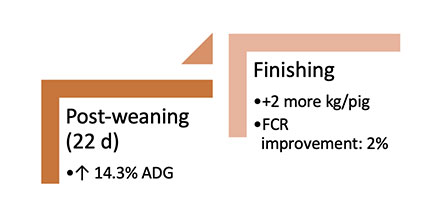
This increase in gene expression and protein synthesis is correlated with greater feed absorption, a better digestion and, afterwards, better feed conversion rate and growth. In addition, enterocytes are new and stronger and can resist infections caused by different pathogens, particularly at weaning.
In pigs, the product has been widely studied in vitro and in vivo. Histological results show the improvement of the structure of the mucosa (see this image).

-
Alquernat Zycox
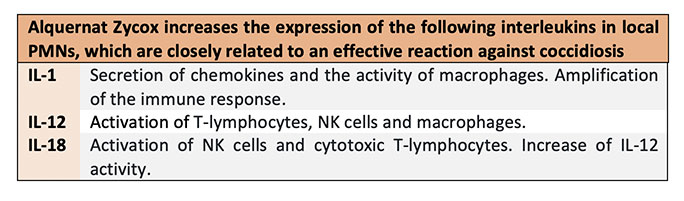
Also based on the technology of pronutrients, in this case, those that stimulate the activity of the intestinal local immune system. They up-regulated genes so that the local immunity is active at physiological levels and can eliminate coccidia that enter the digestive tract.
Alquernat Zycox is effective against all coccidian genres and strains and does not create resistances. It can be administered in liquid, directly to the mouth of newborn piglets to prevent neonatal coccidiosis.
-
Alquernat Inmuplus
It contains prontutrients that boost the immune system of the animal (innate and adaptative) and naturally increase the animal capacity to fight infections.
There are several options to use the product:
- Continuously, as a general immunobooster, to prevent infections.
- During stressful and challenging periods, to prevent the consequences of immunosuppression.
- In combination with vaccinations, to boost their efficacy and obtain higher antibody titers (better protection)
- To pregnant and lactating sows, to improve the colostrum’s immune quality and achieve a greater immunity of the piglets.
Alquermold Natural
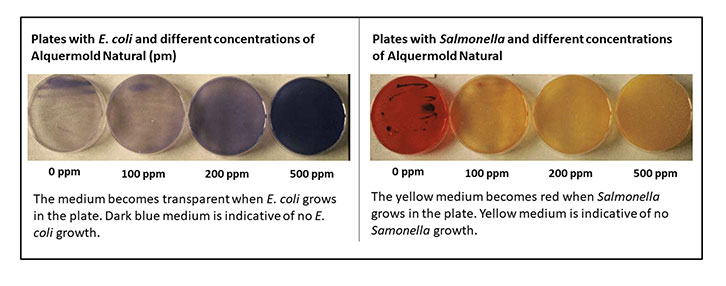
Alquermold Natural is a plant-based product composed of the cimenol ring and citric acid. Cimenol comes from several plant extracts and, in combination with citric acid, is highly effective against pathogenic microorganisms such as Salmonella, E. coli and Clostridium.
If administered continuously, in challenging periods or at the end of the productive cycle, it helps to reduce the CFU of pathogenic bacteria, prevent enteric disorders caused by these bacteria and reduce the risk of zoonosis.
In addition, one in vitro study showed its efficacy against PEDv, but these results need to be corroborated in vivo.
Conclusions
Enteric disorders take an important toll in pig producers in the US annually, and several prevention methods were developed, such as vaccinations.
Due to the increasing limitations in the use of antibiotics to control the intestinal flora and the immunosuppression caused by stressful periods, producers call for more effective solutions that replace and/or complement the existing ones.
Pronutrients and the cimenol ring are good options to include in the prevention programs, since they help to improve the status of the intestines and the immunity, to make animals more resistant to suffer infections, and to eliminate the bacteria with capacity to cause infections (E. coli, Clostridium, Salmonella) from the gut without interfering with the beneficial flora.
Pronutrients and the cimenol ring have been tested in US farms with promising results.
Pronutrients are marketed by Biovet S.A. under the names Alquernat Nebsui, Alquernat Zycox y Alquernat Immuplus. Cimenol ring and citric acid are marketed as Alquermold Natural. These products are available in powder and liquid to be mixed in the feed or the drinking water, for conventional and organic production.
This patented technology has been described and developed by Biovet, S.A.
Bibliography:
- Songer, J. G., & Uzal, F. A. (2005). Clostridial enteric infections in pigs. Journal of Veterinary Diagnostic Investigation, 17(6), 528–536. https://doi.org/10.1177/104063870501700602
- VanderWaal, K., & Deen, J. (2018). Global trends in infectious diseases of swine. Proceedings of the National Academy of Sciences of the United States of America, 115(45), 11495–11500. https://doi.org/10.1073/pnas.1806068115
- Wills, R. W. (2000). Diarrhea in growing-finishing swine. The Veterinary Clinics of North America. Food Animal Practice, 16(1), 135–161. https://doi.org/10.1016/S0749-0720(15)30140-7



MV. Júlia Pié Orpí
Veterinary Technical support to the area of Latin America at Biovet S.A. Laboratories Official Veterinary Services (SVO) in poultry slaughterhouse
CATEGORIES
- Antibiotics
- Antioxidants
- Aquaculture
- Deodorizer
- Digestives
- Dissemination
- Enzymes
- Events
- Farm management
- Farm management
- Fats
- Feeding
- Flavorings
- Immunostimulants
- Microbiocide
- Mycotoxins
- Nutritionals
- Pathology
- Pharmacology
- Poultry Farming
- Preservatives
- Pronutrients
- Ruminants
- Swine
- Technology
It may interest you
Best practices in poultry egg handling: how GI-OVO equipment is changing the industry
Importance of calcium in laying hens

Prevalence of necrotic enteritis in Bangladesh in 2023

The importance and role of 𝙇𝙖𝙘𝙩𝙤𝙗𝙖𝙘𝙞𝙡𝙡𝙪𝙨 in factory-farmed animals

Innovation in poultry vaccination: How to improve the health and performance of farm animals?


Leave a Reply
You must be logged in to post a comment.